
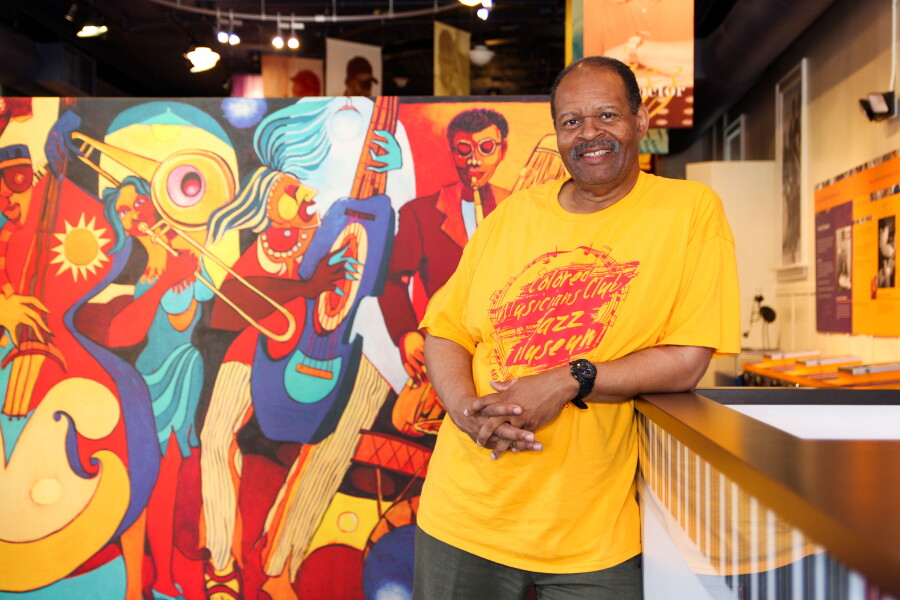
George Scott, president of the Board of Directors for the Colored Musicians Club and Jazz Museum in Buffalo, New York, was only an adolescent in the late 1970s when he started brushing up on his saxophone skills among professional musicians. Thanks to the recommendation of a friend, he attended a workshop at the club and soon began practicing with the bands of Black musicians who toured the country.
“They told me stories about being on the road that would’ve made your hair stand up,” he says. “Through everything they had to deal with during segregation and people wanting to kill them, they still played.”
More than just a safe space for Black musicians to practice their craft, the club, formed shortly after the Colored Musicians Union was established in 1917, became a hub for local and touring jazz musicians. Sunday jam sessions saw the likes of Nat King Cole, Billie Holiday, and Duke Ellington, and today, the club is the only continuously running Black-owned music venue in the United States. As the club prepares to unveil a $3 million expansion and renovation this spring, we spoke with Mr. Scott about his plans for the space, as well as the importance of Buffalo’s rich Black history as it continues to be celebrated, preserved, and shared by local historians and leaders.

The restored interior of the Michigan Street Baptist Church, a key Underground Railroad site and cornerstone of Buffalo’s Black religious and civic life.
Courtesy of Visit Buffalo
A revitalized historic corridor
The Colored Musicians Club and Jazz Museum is one of four anchor spaces located within Buffalo’s landmark Michigan Street African American Heritage Corridor, a neighborhood on the eastern edge of downtown dedicated to preserving Buffalo’s rich Black history. Currently, the corridor is undergoing a major transformation to revitalize the energy of the past for future generations.
The Michigan Street Baptist Church (built in 1845), which unveiled a multi-yearlong interior restoration last January, was a key stop along the Underground Railroad and a meeting place for civil rights leaders who later formed the Niagara Movement, a precursor to the NAACP. The church pastor at the end of the 19th century, Rev. J. Edward Nash, was vital to the church’s social and political efforts and community activism for 61 years until his retirement in 1953.
Many of Nash’s sermons and letters are kept and displayed at the Nash House Museum, his impeccably preserved former residence where Nash often hosted well-known leaders like Booker T. Washington and Rev. Adam Clayton Powell, Sr. Nearby is WUFO Black Radio History Collective, western New York’s only Black-owned radio station; it will reopen later this year as the nation’s first museum dedicated to Black radio.
“All of these landmarks were very important for the Black community, particularly back in the heyday,” recalls Scott. “The Michigan Street Baptist Church, that was the first church that my parents went to when they came from Alabama. Reverend Nash helped organize the Niagara Movement and founded the Buffalo Urban League. These places mean a lot not only to the community, but also to the country.”

A couple shares a dance during a live set at the Colored Musicians Club and Jazz Museum, where jazz remains a vibrant part of Buffalo’s living Black cultural legacy.
Photo by Nancy J Parisi
As each of the anchor spaces undergoes restoration, the corridor continues to broaden its outreach by engaging with visitors through tours, programs, and exhibitions. Programs with organizations like the Buffalo History Museum—a partner in an upcoming Black History Month event exploring the evolution of jazz—bring these stories directly into the community. Such gatherings are opportunities to highlight Buffalo’s impact on music history, both locally and nationally.
“When we get people in from different places like Detroit, Chicago, Pittsburgh, [and] New York, they didn’t realize just how big a deal music was here and who came here,” reflects Scott. “A lot of them were surprised. Very, very surprised. And they want to coordinate with us now, you know, because they were so impressed by our history and legacy.”
For Scott, the most exciting part of the club’s reopening is the chance to engage young people with Buffalo’s Black cultural legacy and pay it forward.
“The number one thing is just having young people get the feel for what their predecessors did for them,” he says. “If they have a better understanding about the [Black] history of Buffalo and the music scene here, then we’ve done our job.”

Contemporary works on view at the Buffalo AKG Art Museum reflect the city’s ongoing investment in Black art, culture, and public storytelling.
Photo by Sharon Cantillon
How and where to celebrate Buffalo’s Black culture year-round
Music, art, and culture are woven throughout Buffalo’s neighborhoods, with numerous murals, cultural landmarks, and gathering spaces to explore. Many remind visitors of how deeply Black history is embedded in the city. Every June, Martin Luther King Jr. Park comes alive for the annual Juneteenth Parade and Festival. Celebrating its 50th anniversary in 2026, the festival is one of the largest Juneteenth celebrations in the country.
Every July, the Colored Musicians Club presents its annual Queen City Jazz Festival, a free and lively celebration in downtown Buffalo’s Lafayette Square that honors the incorporation of the club. Neighboring hotels such as the Hotel at the Lafayette, located right across the square, the Mansion on Delaware Avenue, a few blocks away, and the Richardson Hotel in the nearby Elmwood Village, offer both historic charm and convenience.
Jefferson Avenue on Buffalo’s East Side is a historic hub for Black-owned businesses. Places like Zawadi Books, which specializes in selling books by and about people of African descent, continue to operate and keep this legacy alive. A couple of blocks away is Golden Cup Coffee, a must-visit neighborhood spot for coffee and breakfast. Other surrounding landmarks include the Challenger Community News office, the Apollo Media Center, and the Frank E. Merriweather, Jr. Branch Library, staples of Black news media and providers of educational resources on local history. Further down Jefferson Avenue, Sunshine Vegan Eats offers a wide variety of vegan-friendly comfort foods.
Local history blends with fine art at the Burchfield Penney Art Center, a regional museum dedicated to artists from the Buffalo area; it offers a diverse schedule of exhibitions and programs that provide various insights into Buffalo’s art history. Across the street is the Buffalo AKG Art Museum, a large and internationally renowned art institution that hosts a public art program that commissions projects around the city, including the 2017 Freedom Wall. Located at the northern entrance to the Michigan Street African American Heritage Corridor, the 28-portrait mural highlights local and national Black historical figures who have played key roles in the fight for civil rights and social justice.


