
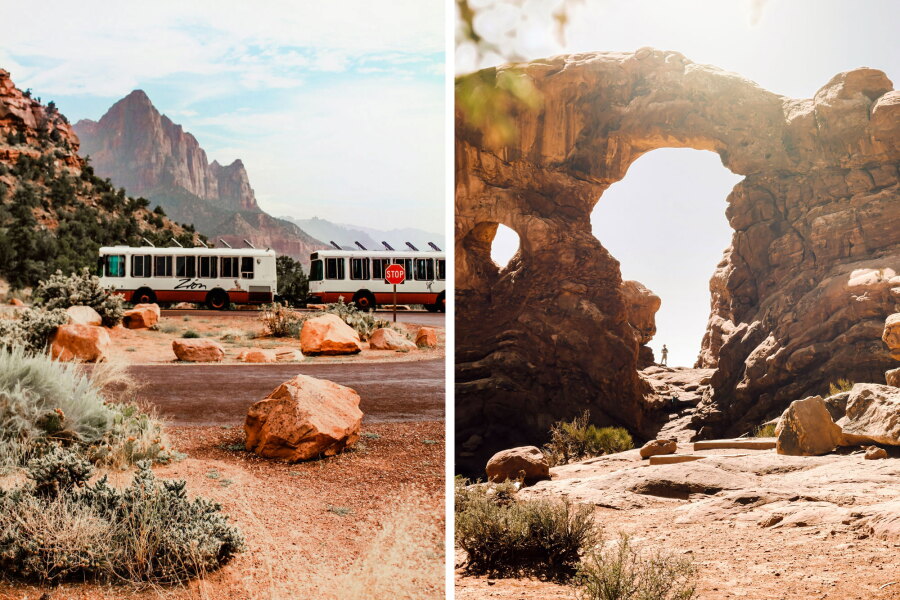
The first time I visited one of Utah’s national parks, I was baffled that anything on our humble planet could look like that. Now, having lived in Salt Lake City part-time for the past three years, I’ve realized each of Utah’s “Mighty Five” delivers its own slap of “wow.” Though it can be tempting to try to see as many parks as possible while in the state, with long driving distances and different planning logistics, it’s not easy to get to all of them in one go. That’s evident with two of the state’s most iconic parks: Zion and Arches.
“It’s not straightforward to get between the two,” says Erika Pollard, a campaign director for the Southwest Region of the National Parks Conservation Association (NPCA). “Southeastern Utah is massive.” It can take 4.5–5 hours to drive from one to the other. She adds, “I would recommend people stay in a place and get to know that place rather than trying to do it all at once.”
Zion, located in Utah’s southwest corner, dazzles with its sage-lined, river-carved canyons and access to nearby heavy hitters like Bryce Canyon National Park and even the Grand Canyon.
Arches, on the east side of the state, offers miles of vast, open desert dotted with martian-like sandstone formations—such as the one depicted on Utah license plates. It’s also situated near Moab, an artsy desert town that is the basecamp for numerous other adventure destinations, including next-door Canyonlands National Park and multiple state parks.
So, if it’s worth picking one to visit first, which is the better option? Here is a comparison of the parks, hotels, and activities visitors can experience in each place to help make your decision easier.

Arches has fewer visitors, more space to wander around, and Mars-like landscapes.
Photo by Dino Reichmuth/Unsplash
Which park has a better location?
Arches, typically reached from Salt Lake City, is harder to drive to, but there’s more to do nearby once you arrive. Zion, on the other hand, is easy to reach from Las Vegas, but its other nearest attractions (like the Grand Canyon) are more spread out.
Arches’ location
Arches National Park is more accessible for visitors coming from Salt Lake City, Park City, or Denver—although it’s still a four- or five-hour drive from those major hubs. You could also fly to a small airport or take the luxury Rocky Mountaineer Canyon Spirit train to Moab, the gateway town less than a 10-minute drive from the park entrance.
Visitors usually base themselves in Moab, known for its gear shops, galleries, cafés, lodges, and red-rock backdrop. About a half hour on the other side of town sits Canyonlands National Park, which has ripples of seemingly endless canyons stretching to the horizon. They offer a playground for hiking, biking, rafting, and climbing.
Nearby state parks also abound. Less than a 30-minute drive away, Utahraptor State Park has some of the largest dinosaur fossil beds in North America, while Dead Horse Point State Park is known for its striking views of the Colorado River. Arches is also a short drive from some of Utah’s beloved national monuments, including Bears Ears (towering buttes and Indigenous heritage sites), Natural Bridges (massive stone arches you can hike beneath), and Hovenweep (ancient Pueblan ruins from 1200 C.E.). More adventurous folks can visit Fruit Bowl, a peninsula overlooking a canyon known for its highlining, a sport similar to tightrope walking that involves balancing on a strip of nylon webbing anchored between canyon walls (with a harness, of course). Castle Valley, the Moab Sand Hill, and Mill Creek Canyon Trail are mellower hiking options.
Zion’s location
Zion National Park is generally considered easier to get to, due to its proximity to Las Vegas. Many guided tours offer packages from Las Vegas to Zion (about a two-hour drive), Bryce Canyon National Park (about 1.5 hours driving), and the Grand Canyon (about five hours to reach the South Rim).
Nearby Bryce Canyon is known for its hoodoos—orange and pink “chimneys” shooting vertically out from the ground. They look like they’re from another planet. You could also drive for about an hour from Zion to Sand Hollow State Park for swimming and paddling among the stark red sandstone scenery, and Kanarra Falls for a beautiful, less popular slot-canyon hike. There’s also the new Zion Canyon Hot Springs nearby, which has 54 geothermal pools for relaxing and unwinding.
Zion doesn’t have a distinctive basecamp town as Arches does with Moab, but the smaller surrounding towns of Springdale and Virgin provide a mix of lodging, dining, and shops. There’s also St. George 30 minutes south (which also has its own regional airport, for those willing to pay more), where visitors can get “big-city” conveniences like more hotels, restaurants, and name-brand stores.

Zion’s hikes are harder and competitive, but the views are more colossal.
Photo by OverlandTheAmericas/Shutterstock
What park has better views?
Canyons carved by the Virgin River define Zion—although among the sagebrush, you may be competing with others at the lookout points. Arches feels more otherworldly and like a quintessential “desert” (sandstone, cacti, red rock). It also has more wide-open vistas.
Arches’ views
Arches is known for its sweeping sandstone arches, towering spires, giant fins (tall, slender, wall-like ridges carved by wind and water), and other geological formations. There are some 2,000 arches in the park, some spanning more than 300 feet in the air. Formed by sandstone once buried beneath a sea, the formations were eroded by wind, rain, and ice, creating unusual shapes that are in the process of falling down and will one day collapse (as Wall Arch did in 2008). But with only 1.4 million visitors each year, you may have enough room to see the teetering rocks before they crumble. Note that in peak season from April through October, you will likely need to make a timed-entry reservation to visit the park—a step the park is experimenting with to mediate crowds.
Zion’s views
Zion is part of a cascading series of colorful cliffs leading to the Grand Canyon. The Virgin River carved out the canyon like sandpaper scraping stone, and it continues to whittle those walls. While it looks serene, the park is infamous for fast-moving flash floods that can surge through its slot canyons after rainstorms, even distant ones.
The views often come at the price of permits, hours of hiking, and jostling heads. “Zion is one of the most visited national parks in the national park system,” says Cory MacNulty, another campaign director for the Southwest Region of NPCA. Given its proximity to Las Vegas, MacNulty says the park sees around 5 million visitors a year—that’s more than Yellowstone, with Zion at only one-fifteenth of Yellowstone’s size.

Hikers in Arches are rewarded by mind-blowing rock formations.
Photo by Lucas Alexander/Unsplash
Which park has better hiking trails?
Zion is known for its “bucket list” hikes that require ample planning and permitting in advance. While you can find easier hikes here, they’re trickier to get to. For families and casual recreators looking for grand vistas with less effort, go to Arches National Park.
Arches’ trails
Pollard agrees that Arches is the more accessible park. Aside from the Fiery Furnace (a popular labyrinth of natural cliffs, fins, and arches that only allows visitors by foot), few permits are required here. “The rest of it is really open and accessible,” she says.
Some of its most famous hikes include the trail to Delicate Arch (the image from the Utah license plate), Landscape Arch, and Double O Arch. Other popular hiking spots include the Fiery Furnace, Devils Garden, Balanced Rock, and the Garden of Eden. Pollard adds, “There are more primitive trails in different areas of the park where there are less people.”
Zion’s trails
Zion’s best-known attractions include Zion Canyon, Angels Landing, and the Narrows. Angels Landing is a strenuous, permit-only hike up 1,488 feet on a cliff. Parts of the Narrows are strenuous, too, and can require permits and canyoneering down into the slot canyons. Other notable trails include the Emerald Pools Trail, Canyon Overlook Trail, and the Riverside Walk. Canyoneering, rock climbing, and bouldering are especially popular in this park, given the quality of the rock.
“Zion has a very short off-season now,” says MacNulty. “To get a much more immersive experience and to find places with natural solitude, you need to get off those road areas and get deeper into the park.” Most of Zion is actually designated wilderness that provides ample opportunities to get off the beaten path—but you’ll need to plan ahead.
Kolob Canyons, far less traversed than much of the park, is a 57-mile-long canyon district in the park’s far northwest corner. You can spend your day wandering around the trails and tranquil creeks carved between the sandstone walls, or drive along the five-mile Kolob Canyons Scenic Route for panoramic views of the landscape. This area is notable for incredible hiking, camping, and climbing away from the crowds in Zion Canyon.

Glamping is a dream anywhere in Utah’s deserts, such as in one of Ulum’s 50 all-suite tents.
Courtesy of Ulum
Which park has better hotel and restaurant options?
Arches offers a broader variety of hotels and restaurants thanks to its proximity to Moab, while Zion delivers a more curated—but still premium—set of stays.
Arches’ hotels and restaurants
Accommodation options are ample near Arches thanks to Moab’s wide-range of glampsites, hotels, Airbnbs, and lodges. Ulum Moab, a “tent resort” with two Michelin keys, provides travelers a luxurious desert homebase. For an elevated, all-inclusive experience, travelers can stay at the Sorrel River Ranch & Spa that overlooks the Colorado River. Closer to the national park is Red Cliffs Lodge Moab, whereas downtown offers the Hoodoo Moab.
For dining, downtown Moab has upscale restaurants like the Sunset Grill, serving dishes like filet mignon, wild ahi tuna, and raspberry duck, and Desert Bistro, where you can order southwestern-inspired cuisine like bison empanadas and a lamb porterhouse. The River Grill at the Sorrel River Ranch is a bit of a drive but worth a visit for its seasonal, farm-to-table menu including the tender double bone-in pork chop and savory wild mushroom ragu.
Zion’s hotels and restaurants
For visitors who want to stay as close as possible to Zion’s dramatic landscapes, there’s one in-park option that’s not a campground: the historic Zion Lodge, with homey, rustic suites and 15 private cabins adorned with wood finishes, stone fireplaces, and linens with desert-inspired designs. Premium options outside the park include Cliffrose Springdale, which has riverside gardens and private canyon- or river-view balconies in each room, and the new Red Cliffs Lodge Zion, set against a backdrop of crimson mountains with modern suites and private patios under the stars. Glampers can sleep in plush beds under safari-style tents and relax around the campfire with a glass of wine or a local beer at resorts like Open Sky, Under Canvas, and the Zion Wildflower Resort. And for a high-luxe option further away (1.5 hours driving), there’s the iconic Amangiri, known for its serene spa, off-the-grid seclusion, and minimalist desert design that blends seamlessly with the landscape.
Fine dining is mostly available in Springdale, with options like Anthera, which serves regionally sourced dishes like Arizona beef tenderloin, salpicon (a cold shrimp salad), and sego noodles. For Italian fare, enjoy fresh pasta, stone-hearth pizza, and other classics at Dulivia. Or dine on Asian and South American food at Añu (located in Hotel DeNovo), offering entrées like Peruvian seafood rice, lomo saltado (Peruvian beef stir fry), and beef ramen. For more dining options, go further south to St. George.
So which national park should I visit first—Arches or Zion?
It depends what kind of adventure you’re looking for.
“Zion is more epic—it requires a lot more planning and permitting to do those adventurous hikes, like Angels Landing and the Emerald Pools,” says Briton Black, events manager at the Front Climbing Club in Salt Lake City, former canyoneering guide, and previous competitive climber at the University of Utah. Black—who has been to both of the parks 35 to 40 times—says Arches is a bit more friendly to families and others looking for low-intensity recreation. “You can park your car, take a short 10–20 minute walk, and see the things you see all over the internet.”
Both parks have so much to offer in such different ways that it’s hard to choose one, but if you’re planning a visit and have limited time, Black recommends Arches. “You can go to Arches for two days and have your mind blown, and then go to Moab and have a fun desert experience,” she says. “Zion can be a zoo. . . . It’s incredible, but you have to time it right and know where you’re going.”
If you’re set on Zion, it can absolutely be done with careful planning, early starts, and a willingness to book permits and accommodations in advance to avoid the crowds.
No matter which you choose, remember to do your research ahead of time, stop by the visitor center to talk to a ranger for information, and “pack your patience,” advises MacNulty.


