
Cambodia

Cambodia is smaller than Oklahoma, with a landmass of less than 70,000 square miles, yet it contains some big lures for visitors. At Angkor, one of the world’s most significant archeological sites, 12th-century temples stretch for 150 miles. The Tonlé Sap, a lake within the Mekong River basin, represents one of the most varied freshwater ecosystems on the planet.

More than two million people a year visit Cambodia, heading to the central and northern regions, as well as to the heartlands for temple tours and river experiences. The charming coast also wows, from the colonial architecture of Kampot to the lively seafood markets in Kep, and the natural splendor of Ream National Park.

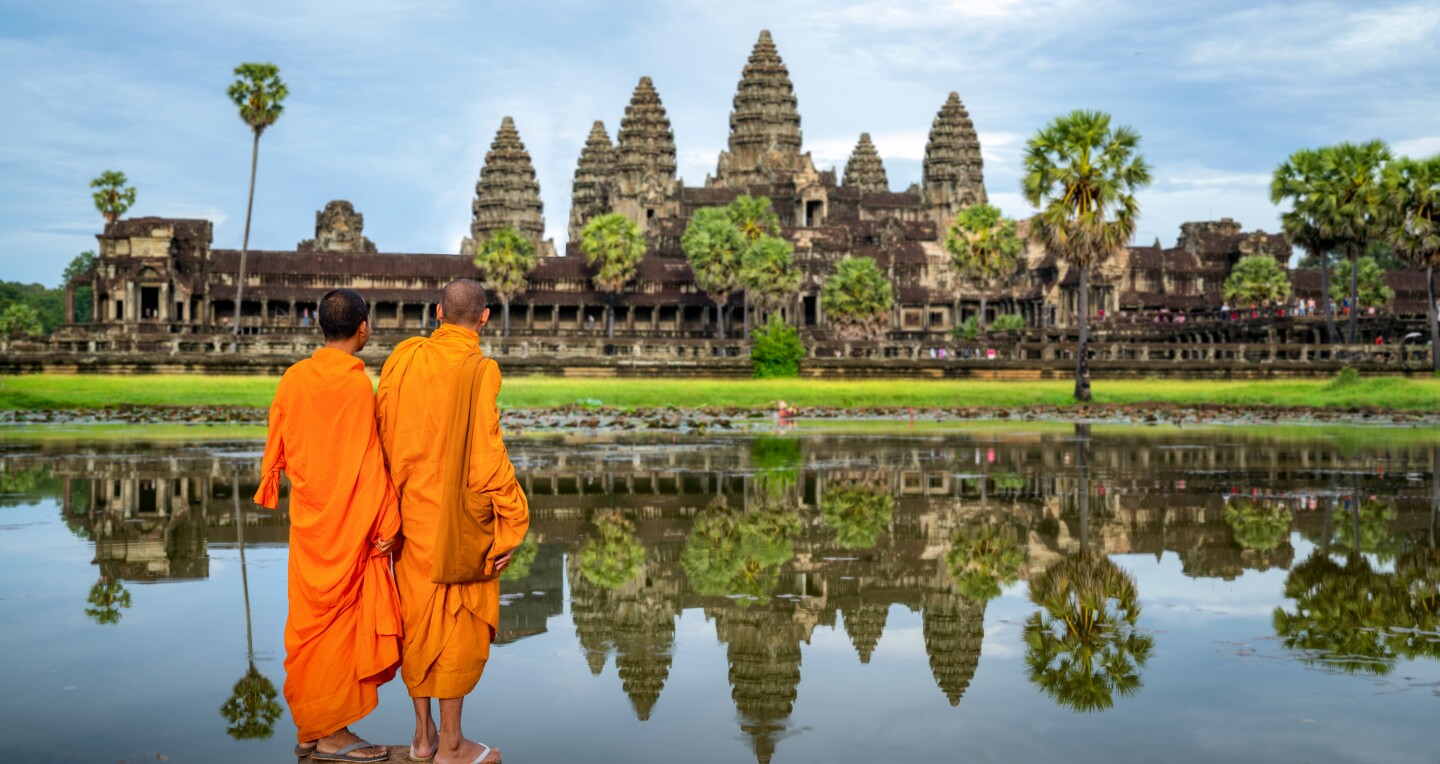
Asian monks stand and look to Angkor wat in siem reap, Cambodia, this image can use for travel and landmark in Asia

Phot By anek.soowannaphoom/Shutterstock

Overview

When’s the best time to go to Cambodia?

Cambodia has two seasons—wet (May to October) and dry (November to April)—and both hold charms abundant.

In November, temperatures at night dip to the low 70s, and while you won’t need a raincoat, you may want an umbrella to shield you from the sun and to put some distance between you and the seasonal crowds at Angkor Wat.

April usually means 100 degrees during the day, but that month’s New Year’s festivities are beautiful, with games and dancing and celebratory dishes like the kralan, a delicious roasted coconut rice cake. It’s easy to fall in love with the romance of the monsoon months, when jungles are at their most vibrant, wildlife is abundant, and crowds are blissfully absent.

How to get around Cambodia

A flexible itinerary and easy-going attitude are optimal, as the few existing highways only began seeing extensive asphalt in 2008.

Flights land daily at Phnom Penh International Airport from major Asian cities, via several carriers. Cambodia Angkor Air flies Phnom Penh to Siem Reap and down to the beaches of Sihanoukville for a few hundred dollars, but charter buses are the cheapest and most common option. Private car with drivers are also popular and can shave an hour off of bus time. A private car from the capital to the coast costs around $60 each way.

Cambodia’s Royal Railway––defunct for decades––is running again, and is a romantic-yet-thrifty option ($7+) for travel to Phnom Penh, Sihanoukville, Takeo, and Kampot. The restored cars offer air-conditioning and bathrooms.

In cities or villages or beach towns, tuk tuks can take you where you want to go. And in Battambang, ride the famous Norry trains, bamboo platforms that ramble along tracks to nowhere and back again, reaffirming that “it’s about the journey, not the destination.”

Can’t miss things to do in Cambodia

Millions of people tour Cambodia’s UNESCO-recognized temples, spending the night in lovely boutique hotels in neighboring Siem Reap. Battambang’s mesmerizing local circus gets press for good reason, and a plate of pepper crab in Kampot is an unforgettable indulgence. The sunsets over the emerald waters and white sand of Koh Rong Islands are Instagram gold, and Phnom Penh’s culinary scene is the latest talk of Southeast Asia.

Food and drink to try in Cambodia

Expect ingredients familiar from Thai food, like lemongrass, lime, coconut, soy, sugar, ginger, and vinegar, but without the intense spice. The most common pepper you’ll find is a peppercorn variety native to Kampot. Amok is the national dish: a slightly sweet coconut fish curry, with turmeric, lime, palm sugar, and fish sauce. Bai Sach Chrouk is breakfast—sliced pork over rice with pickled cucumbers—and never skip dessert. In this former French colony, skilled bakers are plentiful.

Culture in Cambodia

This was a powerful kingdom from the 4th to the 14th century, comprising vast sections of Thailand, Laos, and Vietnam. Cambodia has worked its influence on many Asian arts, from carving to dance, ceremonies to architecture. Family is extremely important to the fabric of life, and traditional marriage remains sacred. In rural areas, unmarried women and men avoid physical contact, as sex before marriage is strongly held social taboo. Children begin school around the age of seven and while the father figure in the family usually holds the authority, Cambodians show great respect to the matriarch as well. In the late 1970s and early ‘80s, the Khmer Rouge regime enslaved and murdered millions. A visit to the Killing Fields of Choeung Ek and the Tuol Sleng Genocide Museum in the capital is an important step to understanding the culture’s troubled past and fervent desire for a bright future. The Phnom Penh City Center project––a real estate venture bringing new housing, entertainment, retail, and restaurants––can provide a happy counterpoint in focus. The project is predicted to draw 200,000 people per day by 2025.

Events

One of the most popular annual events is November’s Water Festival, with colorful boat races and fireworks stretching over three days.

In summer, monsoons flood the Mekong River, temporarily forcing its waters back upstream into the lake of Tonlé Sap and bringing rich nutrients to the lake as well as thousands of fish. This is a bountiful time for eating, drinking, and celebrating.

Most events follow the Cambodian Lunar Calendar—the Chhankitek—but that’s not to say all are religious or agricultural. The Johnnie Walker Golf Tournament at the Phokeethra Country Club in Siem Reap is held in autumn. Marathons are popular, too, including the International Half Marathon in December and the Ultra Trail d’Angkor in January.

For Families

At the Battambang Phare Ponleu Selpak Circus, performers of all ages mix comedy and satire with breathtaking acts under a ‘big top’ tent. This city’s Norry trains are also popular families. Passengers whizz through the jungle on bamboo platforms propelled by small motors. (The rigs were originally used to transport agriculture between villages.) The Russian Market and weekend night market in Phnom Penh offer a million entertaining sights, sounds, and toys for sale, and the koi fish pond at the National Museum is a kid favorite.

Local travel tips for Cambodia

Theft is common in the capital. Avoid wearing jewelry or using your cell phone on the street. Cambodians traditionally cover their knees and shoulders, and this practice is enforced at holy sites and temples. Unmarried women and men avoid touching. Putting your arm around a stranger for a photo or touching a child may be misunderstood.

Guide Editor

Jenny Adams is a full-time freelance writer and photographer, who over the last decade has spent six months a year living in Southeast Asia. She formerly worked for an NGO in Sihanoukville, Cambodia. Jenny catalogs her triumphs and mishaps on her blog, www.BuddhaDrinksFanta.com. She covers food, cocktails, and off-the-beaten-track travel stories for a number of publications.

READ BEFORE YOU GO
Discover some of the best places to visit in Asia, along with why you’ll want to add them to your travel plans this year.
HOTELS
At these 14 luxury resorts, it’s possible to have that dream vacation on a private island—without having to own one.
RESOURCES TO HELP PLAN YOUR TRIP
There comes a time for everyone on a Cambodia trip when, no matter how much you’re enjoying sampling the local food, you’ll get a craving you need to satisfy. Fortunately, Siem Reap has an abundance of restaurants serving cuisines from around the globe, and many of them are very good. Filling pastas are fantastic if you’ve been cycling or scrambling the temples all day and a plain Margarita pizza is a terrific choice if you’ve been a tad sick in the tummy. Of Siem Reap’s handful of Italian restaurants, I love Il Forno, on a narrow alley off Pub Street, just down the lane from Asana and around the corner from Miss Wong.

The pizzas come piping hot from the traditional Neapolitan wood-fired oven and many of the handmade pastas are made fresh daily on the premises. While some of the products, such as the Parma ham, are imported from Italy (as you’d hope!), others are local and seasonal, like the beautiful fragrant basil. They also offer decent Italian wines by the glass and carafe. Check the blackboard for daily specials. If you can’t get a table, I also like Little Italy on the parallel lane on the other side of Pub Street. The specialty there is their excellent carpaccio and house-made charcuterie.
This local institution and late opener is a popular haunt of Siem Reap‘s expats and locals, from archaeologists to artists, poets to tour guides. Laundry Bar’s friendly staff, decent pool tables, and cheap drinks are all big appeals, but it’s the excellent music that continues to draw most local residents to this dimly-lit, bohemian haunt a block from Pub Street. Whether it’s a live band, such as the superb Cambodian Space Project, above, who channel the sounds of Khmer rock ‘n’ roll from the Sixties and Seventies, a visiting Euro-DJ, or the eclectic soundtrack that shifts from jazz and blues to eighties French pop, the music is always interesting and engaging and gets punters tapping their feet or at the very least talking. While the staff will be booting drinkers out in the wee hours of the morning during high season, the bar can often close early (before midnight) during low season, so if you don’t want to miss getting a taste of Laundry, get here by 10pm. A warning: the drinks are cheap but they’re pretty awful. If you want good cocktails, go to Miss Wong. Laundry is all about the cool sounds and casual vibe. Check the bar’s Facebook page to see what bands or DJs are on while you’re in town and plan around it.
Siem Reap sees a lot of Koreans visiting throughout the year, both tour groups and independent travelers. This means the city has a large number of Korean restaurants to cater for them. My favorite is Dae Bak, on busy Sivutha Boulevard. This simple place with stainless steel tables that get packed with groups of tourists, as well as off-duty guides and Korean expats, does deliciously authentic Korean food. There’s a fairly long menu of specialties, including everything from dumplings to kimchi soup and bulgogi to seafood pancakes. A few dishes to share is enough for a couple, as also serve half a dozen tiny dishes of starters, from kimchi to various pickled and fermented vegetables. Dishes start at $5 and a bottle of soju goes for $4. My only gripe is that the Korean BBQ is done outside and not at the table.
The racks at Jasmine Boutique hang with gorgeous handwoven Cambodian silk garments, including exquisitely tailored blouses and trousers, elegant cocktail dresses and gowns, and classic shirts and skirts that can be teamed with anything from crisp cottons for a smart-casual look to sequined tops for a glam night out. The boutique was started in 2001 by Australian Cassandra McMillan and New Zealander Kellianne Karatau, who are passionate about handwoven Cambodian silk, evident in the quality of the beautiful clothes and accessories, such as silk scarves and clutch-purses. They also support other local designers and you’ll find pretty handmade jewelry like the pieces above to team with their clothes. They also have boutiques in Phnom Penh. Jasmine is located in the stylish shopping arcade at the riverside Foreign Correspondents Club or FCC Angkor. Home to Wa Gallery, a branch of Eric Raisina, and the John McDermott photography gallery, it’s easy to spend a couple of hours here browsing these chic boutiques in between drinks and dinner.
Hidden away in the lush jungle south of Siem Reap, the sleepy village of Treak is home to one of Cambodia’s best-kept secrets. In such a tourist-flooded destination, it’s easy to get swept away in the sightseeing infrastructure—both luxury and backpacker—and miss out on local Cambodian culture. But this palm tree–filled oasis of just 10 villa-style rooms has the answer. The hotel is staffed almost entirely by villagers, the sleek modern decor comes from local artisans, water is heated through solar energy, and the restaurant sources its fresh ingredients from nearby farms. Sojourn even has its own NGO, Husk, which works with local families on everything from health to education, providing opportunities for guests to educate themselves and engage with the community in a positive way.

Best of all, Sojourn encourages this responsible tourism without sacrificing a modicum of luxury, from its glassy saltwater pool with a swim-up bar to its custom-made destination dining experiences. The secluded, romantic suites have private gardens, and the decadent spa is the perfect way to bliss out after a day of exploring the dusty ruins.
Opened in 1932 in the historic Royal Khmer compound, this landmark hotel was the first luxury lodging in the area, catering to well-heeled adventurers intent on visiting the storied ruins of the temples at Angkor. Everyone from Charlie Chaplin and Charles de Gaulle to Jackie O and, more recently, Angelina Jolie have slept within its dramatic, art deco walls. Just a short walk or tuk-tuk ride to central Siem Reap, the hotel, now part of the Raffles collection, features 15 acres of manicured gardens with more than 20,540 species of tropical plants, making it a relaxing oasis after a day spent exploring the temples. Following a major restoration by David Grace Designs in 2019, the 119 rooms, suites, and villas—some set in the original main building, others overlooking the garden or pool—are now a vision of French windows, hardwood floors, and marble bathrooms with Italian tiling and oversized rain showers. Some have added perks like furnished terraces, high ceilings, or four-poster beds. Elsewhere in the hotel, features like the 1929 metal-and-timber elevator, art deco black-and-white tiles, and classic conservatory have been refurbished but maintained.

The large central swimming pool is ringed by loungers, while the tucked-away spa has a sauna, Jacuzzi, and six treatment rooms for excellent, regionally inspired therapies. Both in-house and outside guests frequent the six drinking and dining options, which include the legendary Elephant Bar, the elegant Restaurant Le Grand (serving both Western and Royal Khmer cuisine), and the completely renovated Apsara Terrace, which offers a dinner-cum-cultural dance show three or five nights a week, depending on the season. The on-site gallery and boutique showcase high-quality local goods.
If you’ve come to Siem Reap, you’ve already got architectural wonders on the mind. And though you’ll spend your days learning about a 1,000-year-old civilization, a stay at Viroth’s Villa allows a more recent era of Khmer creativity to be contemplated: the 1960s. The decade saw the arts flourish in newly independent Cambodia, most notably in the modernist New Khmer Architecture style.

Viroth’s Villa’s boxy, petite, two-story building is one of the Le Corbusier–inspired genre’s few remaining examples (there are others in Phnom Penh and Kep, on the coast), and its owners, Fabien Martial and Viroth Kol, went to great pains to honor its clean lines and honest aesthetic when renovating the dilapidated building in 2007. Rooms use local materials to modern effect, with dark gray tiled floors and polished terrazzo baths, woven water hyacinth mats, and teak doors. Decor is kept to a minimum—a single standing Buddha, a giant frond from an Elephant Ear palm in a vase—but expertly curated and placed, lending the property the feel of a Southeast Asian art gallery. The intimate, seductive style can also be found in the couple’s second, larger property, Viroth’s Hotel, a newly constructed 1950s-inspired space that opened in January 2015.
How often does a king’s car pick you up at the airport? Arrival at Heritage Suites begins with a vintage 1962 or 1968 Mercedes—one of which used to belong to the late King Norodom Sihanouk—before you’re promptly whisked off to a historic cream-colored building of soaring arches, mahogany columns, and wrought-iron balconies. With just 26 rooms (most of which are suites), the boutique hideaway is often so serene as to feel more like a royal’s private compound than a hotel—if a royal’s compound had its own high-end tour agency and one of the trendiest jazz bars in town. Rooms are spacious and surprisingly modern in style—all suites have a lush private garden, and top-tier rooms also have a private hot tub—and welcome drinks and canapés help guests immediately acclimate to the villa’s languid and decadent atmosphere. The sprawling saltwater pool and its umbrella-shaded sunbeds beckon at all hours (including for romantic candlelit dining), while the intimate spa offers yet another way to unwind in between temple excursions.

Best of all, the hotel gives back: It works closely with the Sala Baï Hotel and Restaurant School, training and hiring students from this school that works with underprivileged Cambodians, especially women, and offers guests opportunities to participate in activities with the school.
Dutchman Dirk de Graaff left a demanding consulting position in Hong Kong to become a hotelier in Siem Reap, falling for Cambodia’s natural beauty, smiling residents, and laid-back way of life. He ran the first gay-friendly guesthouse in town before opening two hotels, a boutique hotel and the more upscale Rambutan Resort, a 16-room property, where he’s successfully re-created the traits that led him to the country in the first place. The simple but stylish rooms employ local, natural materials, with custom-made, chocolate-brown and white-flecked sugar-palm beds (of eco-friendly wood), brightly hued silk lamps, and private outdoor terrazzo soaking tubs. Modern Asian art—including comical pieces by Chinese artist Yue Minjun—adorns the walls. A lovely slate-and-stone tiled, tree-shaded pool anchors the property, its cascading water feature lending a meditative quality.

And though Rambutan’s flair is more than enough reason to stay, it’s the exceedingly personable staff that makes it a true standout. Guests are welcomed like old friends (many are on return visits); the affable check-in crew and servers artfully walk the line between doing their jobs and making time for a chat. De Graaff invests in his team—providing scholarships to further their careers in hospitality, for instance—and their mutual affection for the place shows.
The Sugar Palm restaurant is the first Cambodian restaurant that many visitors to Siem Reap try, and it often becomes a favorite. The food is some of the most delicious, traditional, home-style Cambodian food in the country. It also happens to be served in a very traditional, Khmer teak-wood house, with high ceilings and wide verandahs—oozing atmosphere.


Everything on offer is scrumptious, from the amok trei or fish amok, to the hearty Cambodian chicken curry. If you’re not a fan of pungent and sour flavors but want to try one of Cambodia’s quintessential ingredients, prahok (fermented fish), then this is the restaurant to do it. The prahok k’tis (a minced pork dip made with prahok) is a fairly tame albeit still very tasty iteration of the dish. The owner-chef, Cambodian-New Zealander Kethana Dunnett, is often around if you have questions about the cuisine. Kethana is the go-to person for celebrity chefs -- from Gordon Ramsay to Luke Nguyen -- when they are in the country filming food programs, and she certainly knows her stuff.