

Standing in the unfinished Royal Suite of the Waldorf Astoria London, wearing a hard hat a few months before the hotel’s scheduled February 1, 2027, opening, I’m looking out at what may be the most distinguished hotel room view in Europe.
Peer southwest through the white sash windows, and it’s a straight shot down the Mall, the tree-lined, red-paved ceremonial avenue that was the route of royal processions and state visits for more than a century. At its end, less than a mile away, is Buckingham Palace; its regal balcony lines up exactly with the Royal Suite’s windows. It makes you wonder: How did they manage to put a hotel here?
Why London’s historic landmarks are becoming hotels
In recent years, London‘s secrets have been cracked open. Some of the city’s grandest buildings, long off-limits to the public, have found new life as high-end hotels. Corridors, lobbies, and rooms that were restricted to insiders of British government and industry now welcome all-comers—budget permitting.
As a longtime observer of London’s hotel scene, I’ve rarely seen such a flurry of major openings in landmark buildings: NoMad London in the former Bow Street Magistrates’ Court; Raffles London in the hulking Old War Office; the new Rosewood the Chancery in the former U.S. Embassy; Six Senses in the former Whiteleys department store.

Waldorf Astoria London Admiralty Arch has 114 rooms and suites within one of the British capital’s most recognizable historic landmarks.
Courtesy of Hilton Hotels and Resorts
These buildings are vast, prominent, and often protected by heritage preservation orders. Many of them were formerly owned by the British government, which has sold off huge swathes of its property portfolio in successive rounds of cost-cutting. The splendor, size, and pedigree of these buildings have made them tempting but tricky prospects for adaptation. Converting them into high-end hotels, sometimes with luxury residences attached, can offer a financially viable way to give them new life.
Heritage preservation imposes constraints: protected floor plans and vistas, countless historic details that demand meticulous restoration. But restoration is well worth the challenge for an atmosphere of history and place that would otherwise have been impossible—and an address that new-build developers can only dream of.
The remarkable history of Admiralty Arch
The new Waldorf Astoria London is a perfect case study, and perhaps the most prominent hotel conversion yet. Its home is Admiralty Arch: a landmark that generations of Londoners have passed through. Built in 1912, it was designed as part of the triumphal axis between the Mall and Trafalgar Square.
Watched over by the statue of Britain’s one-armed seafaring hero, Lord Nelson, the arch housed offices for the Admiralty and the home of the Royal Navy’s senior admiral, the First Sea Lord. Winston Churchill and Ian Fleming were just two of the officials who spent time here. At a time when Britain’s navy still ruled the waves, this was where the ruling got done. Walking through the rooms, I could almost sense the ringing of old-fashioned telephones and the ghost of cigarette smoke.
“Grand” hardly does it justice. Between two neoclassical wings of white Portland stone that glows in the evening light, a central section vaults the Mall on three towering traffic arches. (The central passage is normally reserved for royalty.) Corinthian columns, anchors carved into keystones, cast-iron gates, classical statues, and a Latin dedication to Queen Victoria complete the monumental impression.

The transformation of Admiralty Arch into a luxury hotel is part of a wider trend in London, where historic government buildings, former department stores, and other architectural landmarks are finding new life as hotels.
Courtesy of Hilton Hotels and Resorts
However, the building was in a sorry state after the British government moved out in 2011. Its south wing had been converted into humdrum offices, its stonework dulled by a century of traffic fumes. Its status as a Grade I–listed structure (England’s highest tier of historic preservation), especially one with a major street running right through it, meant that any conversion would need to be comprehensive, rigorous, and expensive.
First announced as a Waldorf Astoria hotel in 2017, with an anticipated opening of 2022, the project has faced years of delays and a change of ownership. The British property investors David and Simon Reuben acquired Admiralty Arch in 2022 and have been heavily involved in its restoration.
Inside the new Waldorf Astoria London at Admiralty Arch
Colossal from the outside, the hotel is surprisingly intimate within, comprising only 114 rooms, including four residences (with kitchens) and five suites (without). There are few rooms with an atmosphere as imperial as the imposing exterior; instead, it’s a warren of soft curves. Corridors wrap around semicircular light wells; walls and even doors bend to follow the building’s unusual footprint. The motif of the arch finds its way into the gilded plasterwork in the Peacock Bar or the vaulted ceiling of the underground passageway leading to the spa.
A sophisticated material palette of mahogany, brass, mosaic, and marble supplements carefully restored, century-old plasterwork, glazed brick, and stone staircases. The building’s idiosyncratic floor plan was a particular challenge that became an opportunity to add character.
“It’s never going to be a cookie-cutter type of hotel,” says Stephen Moran, the hotel’s director of marketing and communications. “No two rooms are the same. There are lots of individual quirks and shapes, and the interior designers haven’t tried to force one design into every single space.”
The same attention to detail was applied outside. Every stone inch of the exterior was cleaned and restored. Original shrapnel damage from bombing during World War II was retained. Two nine-foot statues originally planned for the facade (but never sculpted) were finally created and installed, only 112 years late. They now preside over the arch’s central portals, facing Trafalgar Square.
After a century of keeping the public out, Admiralty Arch is almost ready to open, welcoming Londoners as well as travelers through its doors. Its three bars and two restaurants will include Coreus, a fine-dining seafood restaurant by chef Clare Smyth, whose London restaurant Core holds Michelin stars, and Café Boulud, a brasserie by celebrated French chef Daniel Boulud. The latter opens onto a panoramic roof terrace facing the Houses of Parliament, Nelson’s Column, and Buckingham Palace. Visitors who aren’t staying in the Royal Suite can rest assured: The views from up top are equally spectacular.
Bookings at Waldorf Astoria London – Admiralty Arch are now open from February 1, 2027, with doubles from $890.
6 more London landmarks transformed into luxury hotels
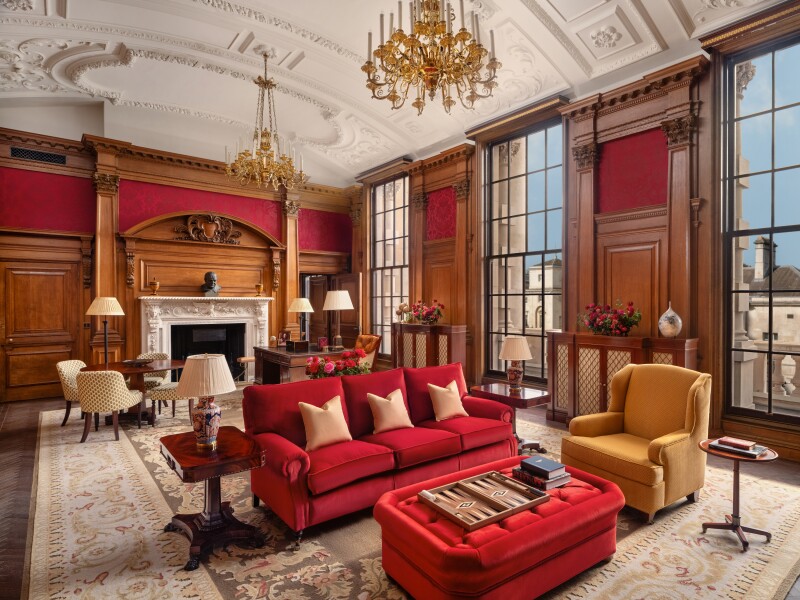
The Haldane Suite at the Raffles London at the OWO was used by the Secretary of State during World War II.
Courtesy of Raffles London at the OWO
Across the British capital, monumental buildings that formerly belonged to government ministries or corporate behemoths have been reimagined as flagship hotels, including these six standout properties.
Raffles London at the OWO
Like Admiralty Arch, the Old War Office on Whitehall dates to the Edwardian era of grandiose construction and was sold off by the Ministry of Defence in 2016. It reopened in 2023 as the Raffles brand’s first London foray, with 120 rooms and suites alongside 85 private residences. From $900
The Chancery Rosewood
Rosewood’s second London hotel, which opened in late 2025, repurposed a major modernist landmark: the former U.S. embassy, designed by Eero Saarinen in 1960. The all-suite Chancery Rosewood is a striking contrast to the original Rosewood London, which occupies the former Edwardian-era headquarters of the Pearl Assurance company, complete with an imposing courtyard and marble lobby. From $1,627
Cambridge House, Auberge Collection

Cambridge House, Auberge Collection, will transform a historic Mayfair mansion that once housed the Naval and Military Club into a luxury hotel, with an opening planned for 2027.
Courtesy of Auberge Collection
Known as the “In and Out Club” after the directions inscribed on its gateposts, the Naval and Military Club left Piccadilly in 1999. Its Georgian home has stood empty ever since, growing increasingly dilapidated. Cambridge House is finally getting another chance courtesy of Admiralty Arch’s owners: The Reuben Brothers are set to open it as a hotel in 2027 under the management of Auberge Collection. From $1,656
The Ned
The former Midland Bank headquarters in London’s financial center sat empty for more than a decade before it reopened in 2017. Its rebirth was led by Nick Jones of Soho House, who named the hotel after its original architect, Edwin “Ned” Lutyens. The former banking hall now teems with restaurants, while a members-only bar preserves an original steel vault door and walls lined with deposit boxes. From $450
Six Senses London

Six Senses London occupies the former Whiteleys department store, marking the wellness-focused hotel brand’s debut in the city.
Courtesy of Six Senses London
Transforming the site of Whiteleys department store in Bayswater, near Notting Hill, Six Senses’ London debut stripped out the non-original interior entirely while preserving the building’s neoclassical facade. The one original element inside is the stately iron staircase, now the lobby’s centerpiece. From $1,087
BT Tower
In perhaps London’s most audacious conversion yet, MCR Hotels bought the BT Tower, once the tallest building in Britain, in 2024. Along with 400 guest rooms, the plans include the public revival of the revolving floor that formerly held London’s highest restaurant, which closed in 1980. The opening is scheduled for 2033. Rates not yet announced


